RAG SaaS
Ship RAG solutions quickly

A end to end SaaS Solution for Retrieval-Augmented Generation (RAG)
and Agentic based applications.
Features ·
Tech Stack ·
Getting Started ·
Deployment ·
Roadmap



| Features |
Demo Video |
- Basic Authentication
- Chat History Tracking
- Multiple RAG Variations
- Basic RAG
- Two additional configurations
- Admin Dashboard
- Data Ingestion
- Monitoring
- ️ Observability
- RAG Configuration Switching
- ️ S3 Integration for PDF uploads
- Easy Deployment with Docker / Docker Compose
|

|
## Tech Stack
- LlamaIndex: For building and orchestrating RAG pipelines
- MongoDB: Used as both a normal database and a vector database
- FastAPI: Backend API framework
- ️ Next.js: Frontend framework
- Qdrant: Vector database for efficient similarity search
- ️ Arize Phoenix: Observability Platform to monitor/evaluate your RAG system
## Why RAG-SaaS?
Setting up reliable RAG systems can be time-consuming and complex. RAG-SaaS allows developers to focus on fine-tuning and developing their RAG pipeline rather than worrying about packaging it into a usable application. Built on top of [create-llama](https://www.llamaindex.ai/blog/create-llama-a-command-line-tool-to-generate-llamaindex-apps-8f7683021191) by LlamaIndex, RAG-SaaS provides a solid foundation for your RAG-based projects.
## Getting Started
1. Clone the repository:
\`\`\`bash
git clone https://github.com/adithya-s-k/RAG-SaaS.git
cd RAG-SaaS
\`\`\`
## Docker Compose Deployment
### Environment Variables
How to Set up .env
### Environment Variables
To properly configure and run RAG-SaaS, you need to set up several environment variables. These are divided into three main sections: Frontend, Backend, and Docker Compose. Here's a detailed explanation of each:
#### Frontend Environment (./frontend/.env.local)
- \`NEXT_PUBLIC_SERVER_URL\`: (Compulsory) The endpoint URL of your FastAPI server.
- \`NEXT_PUBLIC_CHAT_API\`: (Compulsory) Derived from NEXT_SERVER_URL, typically set to \`$\{NEXT_PUBLIC_SERVER_URL\}/api/chat\`.
#### Backend Environment (./backend/.env)
1. Model Configuration:
- \`MODEL_PROVIDER\`: (Compulsory) The AI model provider (e.g., 'openai').
- \`MODEL\`: (Compulsory) The name of the LLM model to use.
- \`EMBEDDING_MODEL\`: (Compulsory) The name of the embedding model.
- \`EMBEDDING_DIM\`: (Compulsory) The dimensionality of the embedding model.
2. OpenAI Configuration:
- \`OPENAI_API_KEY\`: (Compulsory) Your OpenAI API key.
3. Application Settings:
- \`CONVERSATION_STARTERS\`: (Compulsory) A list of starter questions for users.
- \`SYSTEM_PROMPT\`: (Compulsory) The system prompt for the AI model.
- \`SYSTEM_CITATION_PROMPT\`: (Optional) Additional prompt for citation.
- \`APP_HOST\`: (Compulsory) The host address for the backend (default: '0.0.0.0').
- \`APP_PORT\`: (Compulsory) The port for the backend (default: 8000).
4. Database Configuration:
- \`MONGODB_URI\`: (Compulsory) The MongoDB connection URI.
- \`MONGODB_NAME\`: (Compulsory) The MongoDB database name (default: 'RAGSAAS').
- \`QDRANT_URL\`: (Compulsory) The URL for the Qdrant server.
- \`QDRANT_COLLECTION\`: (Compulsory) The Qdrant collection name.
- \`QDRANT_API_KEY\`: (Optional) API key for Qdrant authentication.
5. Authentication:
- \`JWT_SECRET_KEY\`: (Compulsory) Secret key for signing JWT tokens.
- \`JWT_REFRESH_SECRET_KEY\`: (Compulsory) Secret key for signing JWT refresh tokens.
- \`ADMIN_EMAIL\`: (Compulsory) Administrator email for application login.
- \`ADMIN_PASSWORD\`: (Compulsory) Administrator password for application login.
6. AWS S3 Configuration (Optional):
- \`AWS_ACCESS_KEY_ID\`: AWS Access Key ID.
- \`AWS_SECRET_ACCESS_KEY\`: AWS Secret Access Key.
- \`AWS_REGION\`: AWS Region for your services.
- \`BUCKET_NAME\`: The name of the S3 bucket to use.
7. Observability:
- \`ARIZE_PHOENIX_ENDPOINT\`: (Optional) Endpoint for Arize Phoenix observability.
#### S3 Integration
To enable S3 integration for PDF uploads/Ingestion:
1. Set the following environment variables in your \`.env\` file:
\`\`\`
AWS_ACCESS_KEY_ID=your_access_key
AWS_SECRET_ACCESS_KEY=your_secret_key
AWS_REGION=bucket_region
BUCKET_NAME=your_bucket_name
\`\`\`
### Docker Compose Env (./env)
\`\`\`
backend:
build:
context: ./backend
dockerfile: Dockerfile
image: ragsaas/backend:latest
container_name: backend
ports:
- '8000:8000'
environment:
# MongoDB Configuration
MONGODB_NAME: RAGSAAS
MONGODB_URI: mongodb://admin:password@mongodb:27017/
# Qdrant Configuration
QDRANT_COLLECTION: default
QDRANT_URL: http://qdrant:6333
# QDRANT_API_KEY:
# OPENAI_API_KEY is compulsory
OPENAI_API_KEY:
# Backend Application Configuration
MODEL_PROVIDER: openai
MODEL: gpt-4o-mini
EMBEDDING_MODEL: text-embedding-3-small
EMBEDDING_DIM: 1536
FILESERVER_URL_PREFIX: http://backend:8000/api/files
SYSTEM_PROMPT: 'You are a helpful assistant who helps users with their questions.'
APP_HOST: 0.0.0.0
APP_PORT: 8000
JWT_SECRET_KEY:
JWT_REFRESH_SECRET_KEY:
ARIZE_PHOENIX_ENDPOINT: http://arizephoenix:4317
\`\`\`
For Docker Compose deployment, use:
\`\`\`bash
docker compose up -d
\`\`\`
Pull down the containers
\`\`\`bash
docker compose down
\`\`\`
### Development Mode
To run the project in development mode, follow these steps:
1. **Start the Next.js Frontend:**
Navigate to the \`frontend\` directory and install the required dependencies. Then, run the development server:
\`\`\`bash
cd frontend
npm install
npm run dev
\`\`\`
2. **Set Up the Vector Database (Qdrant), Database (MongoDB), and Observability Platform (Arize Phoenix):**
You can either self-host these services using Docker or use hosted solutions.
**Self-Hosted Options:**
- Qdrant:
\`\`\`bash
docker pull qdrant/qdrant
\`\`\`
- MongoDB:
\`\`\`bash
docker pull mongo
\`\`\`
- Arize Phoenix:
\`\`\`bash
docker pull arizephoenix/phoenix
\`\`\`
**Hosted Options:**
- Qdrant Cloud: [Qdrant Cloud](https://cloud.qdrant.io/)
- MongoDB Atlas: [MongoDB Atlas](https://www.mongodb.com/cloud/atlas)
- Arize Phoenix: [Arize Phoenix](https://app.phoenix.arize.com/)
3. **Start the FastAPI Server:**
Navigate to the \`backend\` directory and set up the Python environment. You can use either Conda or Python's built-in \`venv\`:
\`\`\`bash
cd backend
\`\`\`
**Using Conda:**
\`\`\`bash
conda create -n ragsaas-venv python=3.11
conda activate ragsaas-venv
\`\`\`
**Using Python's \`venv\`:**
\`\`\`bash
python -m venv ragsaas-venv
\ragsaas-venv\Scripts\activate # On Windows
source ragsaas-venv/bin/activate # On macOS/Linux
\`\`\`
Install the required dependencies and run the server:
\`\`\`bash
pip install -e .
python main.py
\`\`\`
---
## Roadmap
- [x] add support to store ingested data in AWS S3
- [x] Add Docker compose for each set up
- [x] Implement Observability
- [ ] Improve authentication system
- [ ] Integrate OmniParse API for efficient Data ingestion
- [ ] Provide more control to Admin over RAG configuration
- [ ] Implement Advanced and Agentic RAG
## Contributing
We welcome contributions to RAG-SaaS! Please see our [CONTRIBUTING.md](CONTRIBUTING.md) for more details on how to get started.
## Licensing
This project is available under a dual license:
- Apache License 2.0 for students, developers, and individuals
- GNU General Public License v3.0 for companies and commercial use
See the [LICENSING.md](LICENSING.md) file for more details.
## Acknowledgements
This project is built on the following frameworks, technologies and tools:
- [LlamaIndex](https://www.llamaindex.ai/) for the create-llama tool and RAG orchestration
- [FastAPI](https://fastapi.tiangolo.com/)
- [Next.js](https://nextjs.org/)
- [MongoDB](https://www.mongodb.com/)
- [Qdrant](https://qdrant.tech/)
- [Arize Phoenix](https://docs.arize.com/phoenix)
## Contact & Support
### Bug Reports
If you encounter any issues or bugs, please report them in the [Issues](https://github.com/adithya-s-k/RAG-SaaS/issues) tab of our GitHub repository.
### Commercial Use & Custom Solutions
For inquiries regarding:
- Commercial licensing
- Custom modifications
- Managed deployment
- Specialized integrations
Please contact: adithyaskolavi@gmail.com
We're here to help tailor RAG-SaaS to your specific needs and ensure you get the most out of our solution.
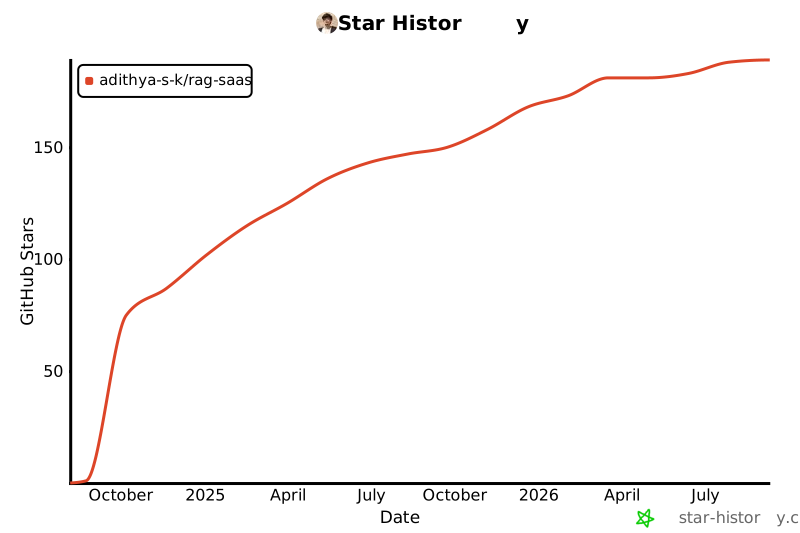
## Star History